Going back more than a hundred years ago, the period from the literary revolution in the late 1910s to the 54th Movement in 1919 was the period when Chinese children's literature was in its infancy. At that time, a fierce struggle was being waged for its realization. The first was against the Confucian view of the child, which did not recognize children's personalities, and the second was against literary texts that were far removed from the language used by children at that time. Lu Xun’s slogan"Save The Children(Diary of a Madman)" opened the curtain on Chinese children's literature, and the theory of "child-centeredness" by Zhou Zuo Ren, and the founding of the weekly children's magazine "Children's World" and "Little Friend" by Zheng Zhenduo and others were the main driving forces behind the emergence of Chinese children's literature. It was created as a result of this.
After liberation, most of the children were given access to education, and children's literature typical of the new China began to be written for children. Especially after the creative movement for children's literature in 1955-1956, the number of writers of children's literature increased and the number of works made a great leap forward in terms of both quantity and quality, which was called the "Golden Age of Chinese children's literature".
However, during the upheaval during the ten years of the Cultural Revolution, the Chinese children's literature was severely damaged. After the end of the Cultural Revolution, the importance of children's literature was reconsidered with the reform and opening-up policy, and the "National First Round Table Conference on the Creation and Publication of Children's Books for Children" was held in Luoshan in 1973, which marked a turning point and a period of development.
"Yan Wenjing"
Our first encounter with Mr. Yan Wenjing was through his selected collection "Xiaoxieryu-style Songs", given to us by Dr. Sun Junzheng, a visiting professor at Osaka University of Foreign Studies in 1980. It is said that "reading is a dialogue with the author", and we were fascinated by the combination of romanticism and realism in his style, and wanted to introduce his works to Japan, so we have translated and contributed them to our coterie magazine "Children of the World". These manuscripts resulted in a publication of “Yan Wenjing’s world, Andersen in China - Nan-nan and a beard man.” I was fortunate enough to meet Dr. Yan Wenjing in Osaka when he came to Japan and had his picture taken with me.
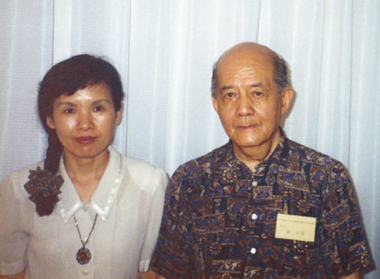
I am deeply moved to think that everything that led me to Chinese children's literature was a trajectory to return to the origins of my encounter with China, which opened the door for me in middle school.
It can be said that the source of the charm of Yan Wenjing's fairy tales is the spirit of "solidarity" and "love" for those in a weak position.
"Mr. Wind's Four Seasons" is an important early work of Gen Wenjing, while "The Tale of the South Wind" is an important work of the author after the end of the Cultural Revolution. They are important milestones not only for individual authors but also for the development of Chinese children's literature.
Publication of " Yan Wenjing’s World, Andersen in China - Nan-nan and a Beard Man."
In order to share with as many people as possible the appeal of Yan Wenjing, the author has compiled nine stories that have been translated into a book. Some of them are presented separately on this website.
'Hong Xuntao'
The first time I met Mr. Hong Xuntao, I was fascinated by his great works, "Ma Liang's Magic Hair pen" and " The Origin of Weasel Hair Brush-pen " and I wrote the essays on his writers and works, and those essays came to Mr. Hong Xuntao's attention. During that time, I exchanged letters with Mr. Hong Xuntao. When I saw my writing in the Preface to the Selected Works, I was very excited and excited to see it.
Mr. Hong Xuntao was one of China's leading children's literature writers and theorists.
He describes the success of modeling in his works as being inextricably linked to human emotions and the importance of creating strong personalities by breaking out of the norm and changing the way we think.
We examined how he himself has constructed this theory in his new work, " The Origin of Weasel Hair Brush-pen”. We also analyzed the artist's artistic depth by comparing it with his previous masterpiece, "Ma Liang's Magic Hair pen ", which also features the brush as its protagonist.
The Translation of "The Origin of Weasel Hair Brush-pen", and the Approach to the Explanation for the Author and His Work
I felt compelled to do something in memory of Hong Xuntao, so I decided to work on a translation and commentary of his work, one of his later masterpieces.
The story is about the protagonist, a weasel who was executed by a human for an innocent crime, and entrusted his grief and anger to his own hair and had a human make a "brush" that could not correct the absurdity of the world. Through this tragedy, the author tried to present to the readers the complexity and contradictions of this world where justice is not always served in real life.
About "The life Story of Ma Liang's Magic Hair pen "
This work is a retelling of an ancient Chinese legend, a short story about Maliang, the protagonist, who daringly confronts the powerful and helps the poor with a magic brush given to him by a hermit. This work is based on the former, and is a biography of Maliang, a story of his adventures and exploits in fifty long stories for children. This work, which took forty-seven years to complete, from its conception in 1946 to its publication in 1993, is an epic work of several hundred thousand words, and contains a translation of this work.
On the Children’s Short Stories in China during the First Half of the 1980's
After the overthrow of the Gang of Four, China entered a second rebirth, and after the Lushan Conference in 1978, Chinese children's literature underwent a dramatic development, and compared to the Golden Age of the mid-1950’s, entered an unprecedented period of development known as the second Golden Age.
This thesis describes the social background and a group of works, and discusses five representative works of each year, namely, Luo Chengsheng's "The 6th grede boy who cannot winding red neckerchief", Zhuang Zhiming's "Xinxing Girls' team captain", Shen Shixi's "The story of seventh hunting dog", Liu Jianping's "Give me back my carving knife", and Changxingang's "The oniy one boat".
On the Social Background of Chinese Children’s Literature during the First Half of the 1980's
This paper is a comprehensive analysis and study of the social context of this period, divided into chronological order.
It describes in detail the expansion of the writer's class, the changing trends in his works, and the situation where the number of publishers and the circulation of children's literature have expanded significantly as a result of the country's commitment to children's literature.
On the Juvenile Short Stories of China in the Last Half of the 1980's
It discusses the social background of children's short stories for children in the late 1980’s and their works in the late 1980’s, including the five major works of each year, Xia Youzhi's "Fubilicious Wind in the Mountains and Fields", Chen Li's "Look for father to Source of the Yellow River", Qin Wenjun's "Say good-by to YiFan", Qilan's "Revenge", and Xie Hua's "The Butterfly in the classroom".
On the fairy tale of China in the early half of the 1980's
It discusses five major works of children's literature of each year: "The answer of mountain" by Liu Bin, "Little dog's little house" by Sun You-jun, " The Origin of Weasel Hair Brush-pen " by Hong Xuntao, "The adventure story of Shuke and Beita" by Zheng Yuanjie, and "Littie cabin with bark chip under the window" by Bing Bo.
On the fairy tale of China in the Last Half of the 1980's
In this paper, we discussed five representative works of the late 1980s, He discussed Zhang Tiesheng's "Ninety-nine Years of Worry and One Year of Pleasure", Yu Qi's "Silent Alarm", Li Renxiao's "Caged Bird", Zhou Rui's "Memoirs in the Forest", and Liu Xingshi's "The fairy of stealing dream".
Changing Images of Children’s Characters
In the 1980’s, a wide variety of figures emerged during this period that were dynamic with new values not seen in the 1950’s and the Cultural Revolution. The figures were explored based on the characteristics of their age, personality and historical background. (1) The exit of heroes and the emergence of troubled children, (2) the emergence of newcomers, (3) deep loneliness, (4) pale love, (5) urban and rural areas, (6) a protagonist moaning about bullying, and (7) a departure for the adult world, etc. Specific examples of each of these are presented.
On "Uproarious Style" in the Chinese Fairy Tales
The rise of Chinese children's storytelling has been a new phenomenon in Chinese children's storytelling during the new era (after 1979, after the Cultural Revolution). This paper analyses and researches the characteristics and problems, its role and potential for future development of this classic storytelling style to be created to enhance its popularity.
A Study of “A Fairy Steals Children's Dreams" Written by Liu Xingshi’
It was first published in 1989 in the 8th edition of “Shonen Bungei” (Children's Literature and Arts), and then reprinted in the 6th edition of the Children's Literature Select Magazine in the same year, and was selected as the best work in the children's story category of the "The first Zhonghua Children's Literature Prose Award". This work was analyzed on the basis of "the idea of inversion", and the author's career, the identity of the fairy, the main character's identity, the theme of the work, the fairy stealing a dream and its purpose, and the use of the fairy's stolen dream, etc., were all examined for their outstanding points.
The term "acceptance" here refers to the one-way method of comparative literature research. It is an attempt to examine the history of exchange between Japanese children's literature and Chinese children's literature to find out how Japanese children's literature understood Chinese children's literature, how it was accepted and influenced by Chinese children's literature, and how it contributed to the emergence, growth and development of Chinese children's literature in Japan. Specifically, this project traces the Chinese elements in Japanese children's literature from many sources and investigates how widely and deeply they have been accepted. Furthermore, the study of how Chinese original works were transformed into Japanese children's literature for children was also considered, taking into account the social background.
Focusing on the Periods from Ancient Oral Literature Times to the Nara-Heian Era
Japanese children's literature for children in the age of oral recitation includes "Ki Ki", "Fudoki", "Manyoshu", "Nihon Ryoiki", "Taketori Monogatari", "Konjaku Monogatari Shu", etc., which were written in Chinese characters, but the descriptions in these books are not purely Japanese, and the influence of China is extremely great. We were able to show that the influence of China was wider and deeper than expected in the legends of Urashima and Hagoromo, which were considered to be indigenous to Japan, and that Chinese children's literature was the basis of Japanese children's literature.
Focusing on Narrative Literature in the Kamakura Era
This was the period of negotiations with the three Chinese nations, the Jin and Sui, or the coming of the Chinese character civilization. Collections of stories were published by monks, scholars, and others in a series of lucid volumes. This essay traces the Chinese reception of these discourses, focusing on "Mongku Waka", "Uji Jyui Monogatari", "Jukunshyo", and "Tang-kyo".
Kamakura-era Buddhist Sermons and China
The traffic between the Kamakura-era Buddhist sermons and China's Song Dynasty led to the Buddhist sermons seeking material from the Chinese sermons, which were actively translated and adapted and incorporated into Japanese Buddhist circles. Taking as an example the two volumes of Li Han's sermons in the Menggui, "Yang Bao Yellow Bird" and "Kong Joy Hougui", which were adopted by the Shushengyi, an excerpt from the Shobogenzo by Dogen Zenith, who was active at the time, the influence of these two volumes was examined.
Focusing on“Otogizosi"
This thesis examines the history of Chinese influence on Chinese children's literature in the "Otogizoshi", a collection of short stories with pictures created from the Muromachi period to the early Edo period, including: (1) "The Tale of Filial piety"; (2) "The Tale of Yang Kifei"; (3) "A different kind of story"; (4) "A love story"; (5) "A tale of heroic courage"; and (6) "The Tale of Honchi".
On Receptivity of Chinese Children’s Literature in “Otogizoushi”
Focusing on“The Story of Koshi"
Among Otogizoshi stories, "The Tale of Filial piety" is the most profound in terms of its Chinese reception. In Chapter 2, the influence of the Japanese "Filial piety tale" and the Chinese "Twenty-four Filial piety tales" are examined and analyzed.
Focusing on "Kanazosi’s Stories"
In order to clarify the reception of Chinese children's literature in the works of "Kanazosi’s Stories“ this paper analyzes the basis of the novels "Tang Yin Biji Monogatari," "Female servants' tale," and "Gu Zhangzi," as well as the aspects of Chinese influence in each part of the novels. It also examines the motivation, purpose, and process by which the novel was accepted by Japanese authors as a crop.
Focusing on the narrative of "Kanazosi’s Stories"
In addition, I have tried to analyze the roots of each of the three sections of "Kanazosi’s Stories": (1) A Tale of Comparative, (2) A Tale of Strange Tales, (3) A Tale of the Filth, (4) A Tale of Tale of Deeds, and (5) A Tale of Laughter, as well as the various aspects of Chinese reception of these works.